Warning: margin trading is not suited for beginners. You should have at least several months of trading experience before attempting to margin trade. Note that using the information below is done at your own risk. This is not financial advice blah blah blah….
Ok, now that we got that out of the way…
Let’s get you started making some of that Bitmex “short trade with 100X leverage” money you’ve heard so many people talking about (btw, never do that…and if you do, you’re an idiot).
Whether you love em or hate em, Bitmex has the potential to take you from zero to hero faster than any other trading method out there. This is potentially the biggest draw to the Bitmex trading platform.
If you have a solid understanding of technical analysis, a trading strategy with a proven track record, and lots of trading experience under your belt, Bitmex may be your “go to” cryptocurrency exchange for some of that quick crypto cashflow.
However, if you’ve only traded for a few weeks and don’t have a solid understanding and proven game-winning trading strategy, Bitmex will wreck you faster than Mike Tyson on acid.
This is for heavyweights only. If you haven’t been through a few battles yet, don’t step inside the ring.
How to Get Started Trading on Bitmex
I highly recommend you open up your Bitmex trading account by using the link here in order to register. You receive a 10% discount on all your transaction fees for the first six months at no additional cost to you. Now do it!
For US Residents…
If you’re a US resident, you need to make sure that you’re either using a UK VPN or private proxy when signing up. I recommend you use BuyProxies.org and purchase their lowest tier package which is $10 per month.
Once you’ve completed your registration, you no longer need the proxies (or VPN if you decide to go that route). You can sign in with your standard US IP (no proxy or VPN) from there on out.
Ok, now that we got that out of the way, let’s get you started with the fundamentals…
Bitmex Margin Trading In Plain English
I’ll start off by defining a few terms that you’ll need to be familiar with in your early stages ….
Margin trading — this is the method of conducting a purchase using cash that is provided to you (the trader) as a loan. In reality, you’re not really “borrowing funds” from any centralized entity, you’re merely swapping out “contracts” with others utilizing the platform.
If you’re shorting, you’re swapping out with someone going long. If you’re going long, you’re swapping out with someone that is shorting.
That’s the gist behind it all. For the sake of this guide, I’ll loosely use the term borrowing.
Leverage — the amount of funds that you decide to borrow. The higher the leverage, the more funds you borrow, and the more risk you take at getting liquidated.
Example: $1000 with 5X leverage = $5000 your trading with. Your liquidation price is given to you before and during your transaction, so you should never be surprised at where it’s at.
Liquidation price — this is the price at which your account balance (or amounts of funds you’re using) is completely wiped out.
Example: $100 with 25% leverage at BTC entry price of $7500 = $6002 liquidation price.
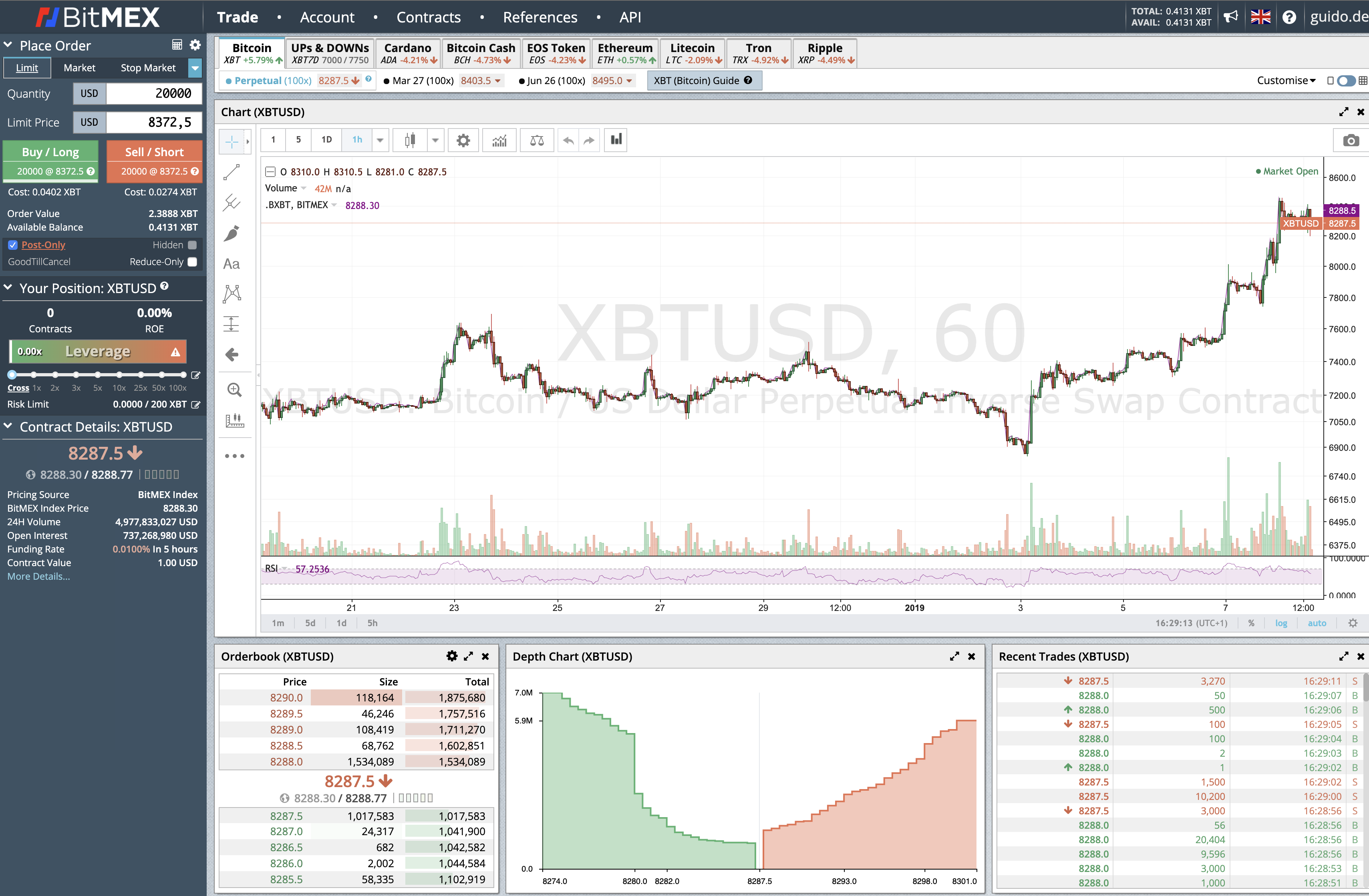
Don’t worry about calculating all this stuff by yourself. Bitmex was nice enough to provide you with a calculator. You’ll never be left in the dark when it comes to your profit, loss, or liquidation price.
Long position — betting that price movement will increase.
Short position — betting that price movement will decrease.
Limit order — (aka market maker) set a price and have it filled once the market reaches your set price. 9 times out of 10, you should be using this for all your trades to prevent paying high fees.
Market order — (making you the market taker) this is where you’ll immediately exit your trade. For having this convenience, you pay 3X the fee (%0.0075 as opposed to %0.0025).
Take Profit — like the name implies, this is where you start taking profits as the price value increases. The opposite applies for shorts. You want to start taking profit below your entry price.
Stop Loss Limit — this is to prevent you from completely losing all your capital from a sudden drop (for longs) or sudden spike (for shorts) in price action. Once a stop loss trigger has been reached your trade initiates your stop loss limit price. Once this limit price has been reached, you’re exited out of the trade. This will ensure that your loss is minimized.
Stop Loss Market — the same as stop loss limit, however your trade will be “immediately exited” at the market price. I highly recommend using this over the stop limit when you’re not close to your computer (or on any occasion for that matter).
When price drops, it drops fast. There’s a good chance that your stop limit price will not activate and you’ll be left holding the bags (debt). Using the stop loss market, ensures you that during a strong dip, you keep your losses to a minimum. You’re guaranteed an exit out of the trade, which again, is not always likely with stop loss limits.
Trailing Stop — think of this as a “moving stop loss” that follows the current price by a set value.
Example: $1000 at BTC entry price of $6500 with a trailing stop loss of $250 would mean that if the price action decreases to $6250, you would be stopped out (exit the trade).
However, if your price increases to $7000 and then drops $250, it would be stopped out at $6750. This is a great feature to use when you’re trade is already in profit.Trailing stops will ensure that you take advantage of quick spikes in price if you’re not by your computer.
Bitmex not only allows you to trade with borrowed money, but enables you to make a profit on both an uptrend or downtrend. No longer will you be confined to bull markets once your familiar with this trading platform. Hell, you might actually look forward to bear markets. You can make just as much during these periods of margin trading than you can within bull markets, if you play your cards right.
Now let’s look at the various ways to leverage your trades on Bitmex…